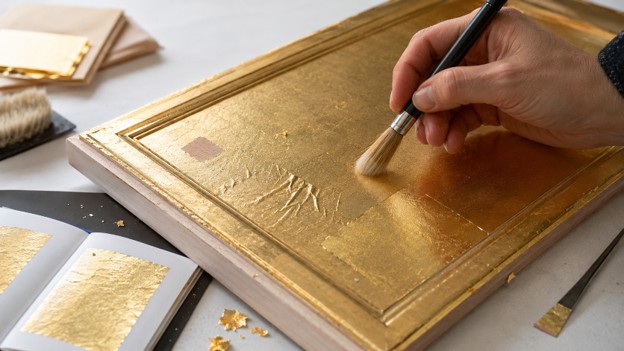
Imitation gold leaf or genuine gold: which should you choose?

Imitation and genuine gold may look similar, but differ in composition, behaviour and applications.
Imitation gold leaf or genuine gold is one of the first choices in a gilding project. Both create a metallic surface, but differ in cost, handling, resistance to colour changes and suitable applications. The right choice depends on area, location, expected use and the finish you want.
What is genuine gold leaf?
Genuine gold leaf is gold beaten into extremely thin sheets. Carat and alloy affect colour and stability. High-carat gold does not oxidise like alloys containing more copper or silver, making it valuable in restoration, religious art and projects requiring authenticity. Thin genuine leaf is sensitive to draughts and handling and requires careful tools and technique.
What is imitation gold leaf?
Imitation gold leaf is a metal alloy, commonly copper and zinc. It is also called composition leaf, Dutch metal or Schlag metal. It contains no gold but creates a gold-coloured metallic effect. Larger formats can make it practical for walls, ceilings, furniture, scenery and decorative production. Its main maintenance difference is potential tarnishing: moisture, air, fingerprints and incompatible chemicals can affect the alloy. A compatible protective finish is usually needed.
Seven key differences
1. Composition
Genuine leaf contains gold; imitation leaf uses other metals. Composition affects the surface behaviour, material value and protective system.
2. Cost and coverage
Imitation leaf is more economical for large walls, ceilings, furniture and multiple decorative objects. Genuine gold is justified when precious metal, historical authenticity or material value is required.
3. Handling
Imitation leaf is generally thicker and easier for beginners. Genuine leaf requires gentler transfer and close control of airflow, tools and handling.
4. Appearance
Imitation creates a strong decorative gold shine. Genuine gold can produce a softer, deeper appearance. Base colour, technique, texture and the protective coating also strongly affect the result.
5. Resistance to tarnishing
High-carat gold is very resistant to oxidation. Unprotected imitation leaf can darken, stain or change colour. Compatible protection slows these changes but does not automatically make every project suitable for outdoors.
6. Protective finish
Imitation leaf usually needs sealing. High-carat genuine gold does not always require a coating, which may change its distinctive shine. The decision depends on carat, technique, location, handling and weather exposure.
7. Value and authenticity
Restoring historical objects or artworks may require a material matching the original. For modern decoration, prototypes, scenery and product series, imitation can offer a practical balance of appearance, speed and cost.
When is imitation gold leaf a better choice?
- For large interior areas or multiple objects
- For a convincing gold effect within a controlled budget
- For learning gilding with a material that is easier to handle
- For furniture, frames, wall decorations, window displays, scenery and crafts
- When efficient coverage and larger sheet formats matter
When should you consider genuine gold?
- For conservation and restoration of valuable or historical objects
- When the client explicitly requires authentic precious metal
- When long-term material stability matters more than initial cost
- For artworks where the distinctive depth of colour is central
- For specialist outdoor gilding using a professionally specified system
Is imitation gold leaf edible?
No. Copper-zinc imitation leaf is not intended for food, drinks, edible decorations or direct food-contact surfaces. Food decoration requires a product explicitly labelled and documented for that use. A gold colour or the term gold leaf is not proof of food suitability.
Loose or transfer leaf?
After selecting genuine or imitation gold, consider the format. Loose leaf follows recesses and carvings but is sensitive to airflow. Transfer leaf, where available, is carried on paper and can simplify flat-surface application. Protective interleaving paper is different from a sheet attached to transfer paper.
Quick decision guide
- Large interior area and limited budget: consider imitation gold leaf.
- Valuable historical object: follow conservation requirements, often specifying genuine gold.
- First craft project: imitation leaf is usually practical for learning.
- Frequently handled object: use a carefully selected protective system or consider a more wear-resistant decorative technique.
- Outdoor project: obtain professional advice for the complete substrate, adhesive, metal and protection system.
Choose according to the result you want
For affordable decorative gilding and larger interior projects, browse imitation gold leaf in our. To compare materials, browse the shop at and assess your substrate, conditions of use and protective finish before ordering.