15 home decorating ideas with imitation gold leaf

Gold accents work best when they highlight texture and form rather than cover an entire room.
Imitation gold leaf is useful beyond traditional frame restoration. It can add a precise metallic accent to modern, rustic, minimalist or eclectic interiors. Combine its shine with wood, ceramics, stone, paint or plaster. Gilding just an edge, recess or irregular area is often enough.
Before choosing a project
Consider handling, washing, heat and moisture. Copper-zinc imitation leaf is decorative, not edible, and must not be used on direct food-contact surfaces. Keep it away from open flames and strong heat. Plan compatible protection for most interior projects.
15 ideas for gold leaf decoration
1. A narrow gold edge on a picture frame
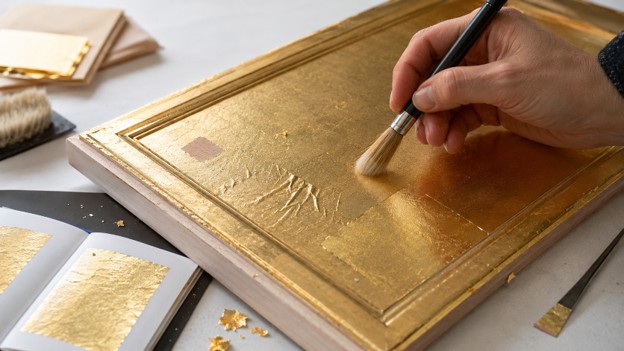
Gild only the inner or outer frame profile. A narrow gold line connects the image and frame with less material than full gilding. It works well with black, dark blue, olive or natural wood finishes.
2. Refresh a mirror frame
Gild carved details, corners or a narrow moulding around an old mirror. Protect the glass with paper and suitable masking tape before applying adhesive and protection.
3. An irregular gold band on a ceramic vase
Create an organic band on a matt vase for contrast between textured ceramics and metallic shine. Keep the vase decorative; do not gild its interior, water-contact rim or food-contact parts.
4. A gold detail on a wooden tray
Gild the outside edge, handles or a small geometric section while leaving the food-contact area untouched. Protect the decoration and clean without soaking.
5. Accented side-table legs
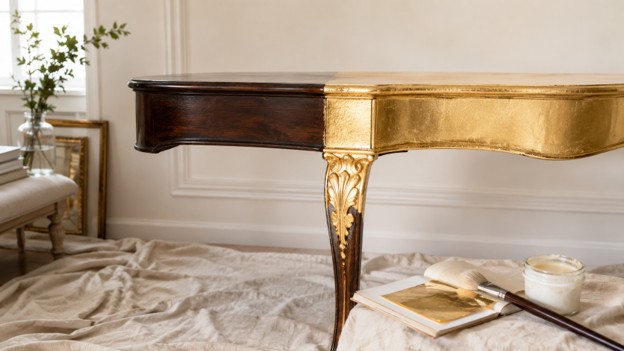
Gild a small section at the top or bottom of the legs. This restrained detail works well on a simple black, white or dark-wood table.
6. Gilded cabinet mouldings
Highlight raised mouldings or recessed borders on cabinet fronts without covering all the wood or paint. Frequently handled pulls are better left with a durable factory finish.
7. An abstract painting with a metallic area
Combine matt paint, texture paste and a gold-leaf area on a stable art support. Irregular edges and visible joins can form part of the composition. Avoid movement that could crack the finish.
8. A wall panel or niche
Gild a small niche background, narrow panel or geometric section instead of an entire wall. Side lighting highlights sheet transitions. Smooth and prime the wall carefully because metal reveals imperfections.
9. Ceiling rosettes and mouldings
Gild raised rosette details while leaving the base white, or repeat a thin gold line along mouldings. Use stable access equipment and manageable sections for overhead work.
10. A table-lamp base
Decorate a lamp base only where it stays cool and remains away from electrical connections and the bulb. Unplug the lamp before working and keep ventilation openings clear.
11. Decorative boxes
Gild a lid, monogram, narrow band or corners of a wooden box. Its small, flat surface makes a useful first project for testing primer, adhesive and protection.
12. Decorative planters
A gilded exterior contrasts with greenery. Ensure drainage and keep the metal finish away from constant moisture. Ordinary indoor protection is not sufficient for outdoor use.
13. Seasonal ornaments
Wooden stars, baubles, eggs, wreaths and other ornaments can be fully or partly gilded. Offcuts and small fragments suit irregular surfaces and small objects.
14. Lettering and house numbers
Leaf adds shine and a handmade finish to wooden or relief lettering. For an outdoor house number, choose a weather-suitable system or a technique better suited to rain and sunlight.
15. Decorative patterns on glass
Create geometric or organic motifs on the reverse of a decorative glass panel. Degrease thoroughly and use an adhesive suited to non-porous surfaces. This technique is not intended for drinking glasses, plates or washable tableware.
Sheets or fragments: which should you use?
Whole sheets suit continuous coverage of flat areas, frames and mouldings. Small fragments suit repairs, ornaments and textured effects. For deep relief, combine larger sheets on raised parts with fragments in recesses.
How to keep gold details elegant
- Repeat the same gold tone in a few carefully chosen places.
- Pair metallic shine with matt wood, plaster, textiles or ceramics.
- Highlight an edge, recess, relief or geometric section.
- Leave neutral space around gilding so the detail has room to stand out.
- Test under daylight and evening lighting before starting.
Turn an idea into a practical project
Choose a suitable imitation leaf format for small ornaments, frames, furniture or larger decorative surfaces. Browse the range in our and explore more examples in our. For professional production and larger quantities, visit our https://zlatnilistici.com/en/wholesale/.